Buy On Amazon
 The Harvard Book Store Top 100 Books
 Amazon’s 100 Books to Read in a Lifetime
 Pulitzer Prize for Fiction
Likes
1
Want to Read Shelf
0
Read Shelf
0
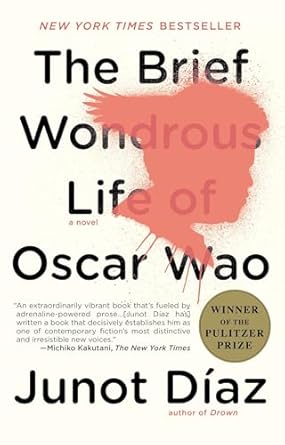
The Brief Wondrous Life of Oscar Wao
Junot Diaz
Junot Díaz’s The Brief Wondrous Life of Oscar Wao is a novel that weaves together history, mythology, pop culture, and linguistic hybridity to explore themes of identity, diaspora, masculinity, love, and the weight of historical trauma, all under the shadow of the Dominican Republic’s brutal political past. The novel’s semantic richness lies in its fusion of English, Spanish, Spanglish, and nerd-culture references, creating a textual landscape that mirrors the hybridity of the immigrant experience and the fragmentation of identity that accompanies displacement. Díaz’s narrator, Yunior, employs a hyper-stylized, irreverent, and often profane voice, layering his storytelling with footnotes, digressions, and direct reader address, blurring the boundaries between historical record and personal anecdote while reinforcing the cyclical nature of history and oppression. The central motif of fukú, the supposed curse that haunts the de León family, extends beyond mere superstition, becoming a linguistic construct that encapsulates the novel’s existential concerns—the way history repeats itself, the way violence and colonial legacies persist across generations, and the way language itself can either sustain or resist these forces. This semantic layering allows Díaz to engage in a dual register of storytelling, simultaneously conveying historical atrocities—particularly the reign of Rafael Trujillo and its enduring impact on the Dominican psyche—while also celebrating the idiosyncratic, often absurd way that trauma manifests in everyday life. The protagonist, Oscar, is an anomaly within both his family and Dominican cultural expectations: a science-fiction-obsessed, overweight, socially awkward dreamer who struggles to reconcile his deep romanticism with the hyper-masculine and often predatory definitions of love and desire imposed upon him. His linguistic detachment from the machismo-driven discourse of his environment highlights his alienation; he speaks in the lexicon of fantasy epics rather than the pragmatic, survivalist register of those around him, which serves to further marginalize him within the diasporic community that expects resilience and performative masculinity as a means of cultural continuity. The novel’s themes of love and destiny play out in tragic irony, as Oscar’s relentless pursuit of love and belonging ultimately leads to his death, reinforcing the inevitability of historical cycles and the inescapable nature of inherited trauma. At the same time, his final act of defiance—choosing love and self-expression despite the violence that surrounds him—suggests a kind of resistance, a redefinition of heroism that transcends conventional Dominican masculinity and instead finds power in vulnerability and narrative self-determination. Semantically, Díaz crafts a linguistic battleground in which the novel’s characters negotiate their place between past and present, between the Dominican Republic and the United States, between history and myth, between reality and the speculative realms of fiction. This blending of high and low culture, of historical gravitas and pop-cultural levity, of multilingual intertextuality and metafictional reflexivity, creates a text that is as much about the limits and possibilities of language as it is about the lives it seeks to represent. By embedding Oscar’s fate within a larger cosmic framework—drawing connections between his personal suffering and the grand narratives of oppression and resistance that have shaped the Caribbean—Díaz highlights how language not only reflects reality but also shapes it, how storytelling can serve as both an act of remembrance and a means of survival. Ultimately, The Brief Wondrous Life of Oscar Wao is a novel that operates on multiple semantic levels, using language as a tool of both oppression and liberation, history as both a burden and a source of meaning, and love as both a destructive force and a radical act of defiance against the erasure of selfhood.